← גרור לסיבוב →
← גרור לסיבוב →
per IEEE C37.118.1
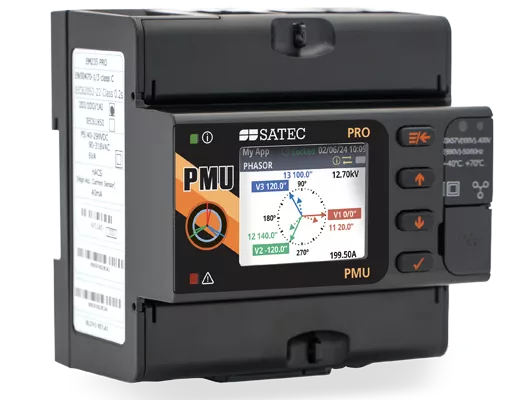
A Phasor Measurement Unit (PMU) is the core building block of a Wide Area Monitoring System (WAMS), providing precisely time-synchronized measurements from different locations across the electrical grid. The SATEC PMU PRO synchronizes measurements to a common UTC time reference using IRIG-B or IEEE 1588 PTPv2 and provides timestamp accuracy of 1 μs. It delivers synchronized voltage and current phasors, frequency and Rate of Change of Frequency (ROCOF), enabling utilities to monitor grid dynamics, stability and disturbances in real time. PMU PRO supports both P-Class and M-Class performance requirements according to IEEE C37.118.1-2011 / C37.118.1a-2014 and IEC/IEEE 60255-118-1:2018.
Synchrophasor data can be streamed over Ethernet using IEEE C37.118.2 or IEC 61850-9-2, with reporting rates up to 200 frames per second on 50 Hz systems and 240 frames per second on 60 Hz systems. PMU PRO can communicate with third-party Phasor Data Concentrators (PDCs) for integration into WAMS and other grid-monitoring architectures.
By interfacing Global Positioning System (GPS) receivers or clocks, or using Precision Time Protocol (PTP) the PMU reaches micro-second precision. This enables it to provide razor-sharp resolution snapshots of the angles formed by the measured parameters.
Providing the highest performance, and incomparably cost-effective, the PMU PRO is a true game-changer, especially in the field of Distribution System Operators (DSO). It communicates with 3rd party Phasor Data Concentrators (PDC), an important WAMS component in itself, enabling versatility.
A PMU is a device that measures synchronized voltage and current phasors, frequency and Rate of Change of Frequency (ROCOF) using a common UTC time reference. PMUs installed at different locations can therefore produce measurements that are precisely aligned in time, allowing grid operators to compare phase magnitude, phase angle, frequency and other dynamic conditions across the power system.
A synchrophasor is a phasor measurement of an AC voltage or current referenced to a common precision time source, so readings from across the grid can be aligned and compared. The PMU is the device that measures and reports these synchronized phasors.
IEEE C37.118 is a family of standards for synchrophasor measurement and communication. IEEE C37.118.1 defines synchrophasor measurement performance requirements, while IEEE C37.118.2 defines the real-time transfer of synchrophasor data. PMU PRO supports P-Class and M-Class performance according to IEEE C37.118.1-2011 / C37.118.1a-2014 and IEC/IEEE 60255-118-1:2018, and supports IEEE C37.118.2 data communication.
PMUs are deployed across transmission and distribution networks, substations and other critical grid locations as part of Wide Area Monitoring Systems (WAMS). Applications include grid stability monitoring, oscillation and disturbance analysis, voltage and frequency monitoring, renewable-energy integration and improved situational awareness across the power system.
A conventional power meter is primarily designed to measure electrical quantities such as voltage, current, power, energy, demand and power quality at a local measurement point. A PMU is specifically designed to measure voltage and current phasors synchronized to a common precision time reference, allowing phase magnitude and angle measurements from multiple locations to be directly compared. PMUs also provide high-speed synchrophasor reporting for monitoring fast grid dynamics. The SATEC PMU PRO supports reporting rates up to 200 frames per second on 50 Hz systems and 240 frames per second on 60 Hz systems, making it suitable for WAMS, grid stability monitoring and dynamic power-system analysis.
PMUs installed at different points in the electrical network stream time-synchronized phasor data to a Phasor Data Concentrator (PDC), which collects and aligns measurements from multiple PMUs for monitoring and analysis. SATEC PMU PRO supports IEEE C37.118.2 synchrophasor communication and can integrate with third-party PDCs as part of a WAMS or WAMPACS architecture.
Built-in I/O
4 Relay Outputs
Electromechanical (SPST Form A)
Available options:
Combo: 4 Digital Inputs + 2 Relay Outputs
Available per above specifications
4 Analog Outputs
Universal (configurable) isolated analog outputs
(±1 mA; 0-1 mA; 0-20 mA; 4-20 mA)
Built-in: 57.7-277V AC / 48-290V DC
Additional options:
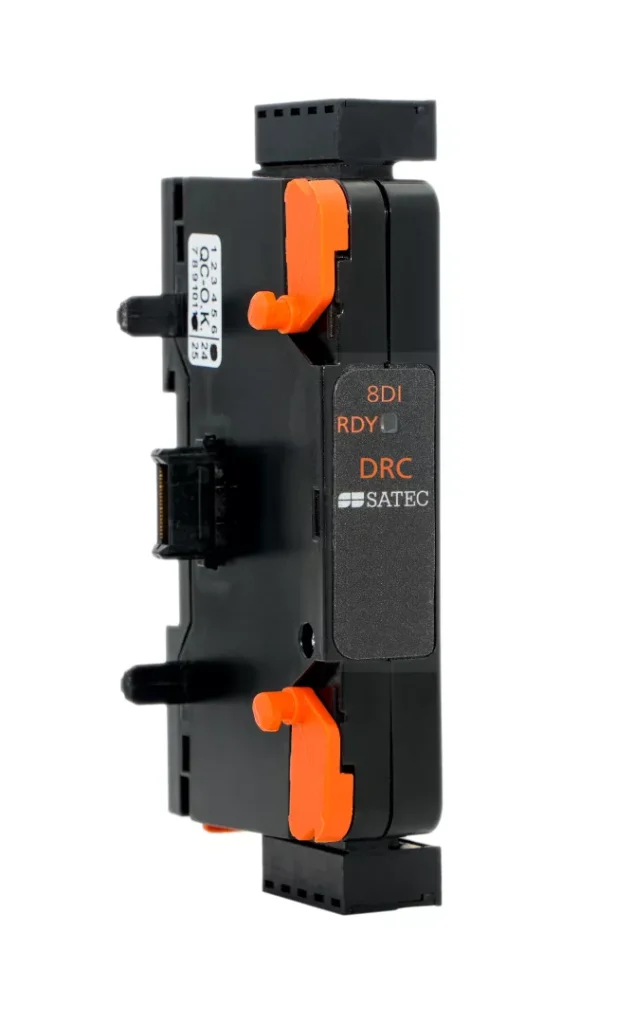
8 optically isolated digital inputs, available as:
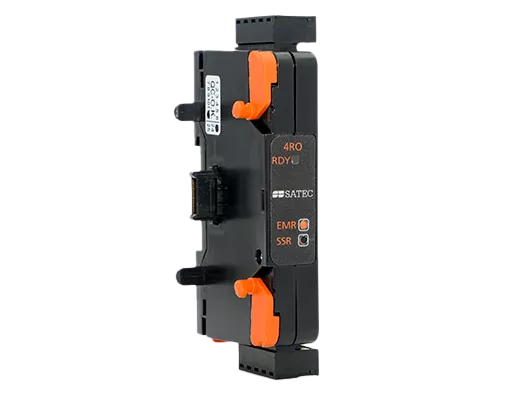
4 optically isolated digital outputs, available as:
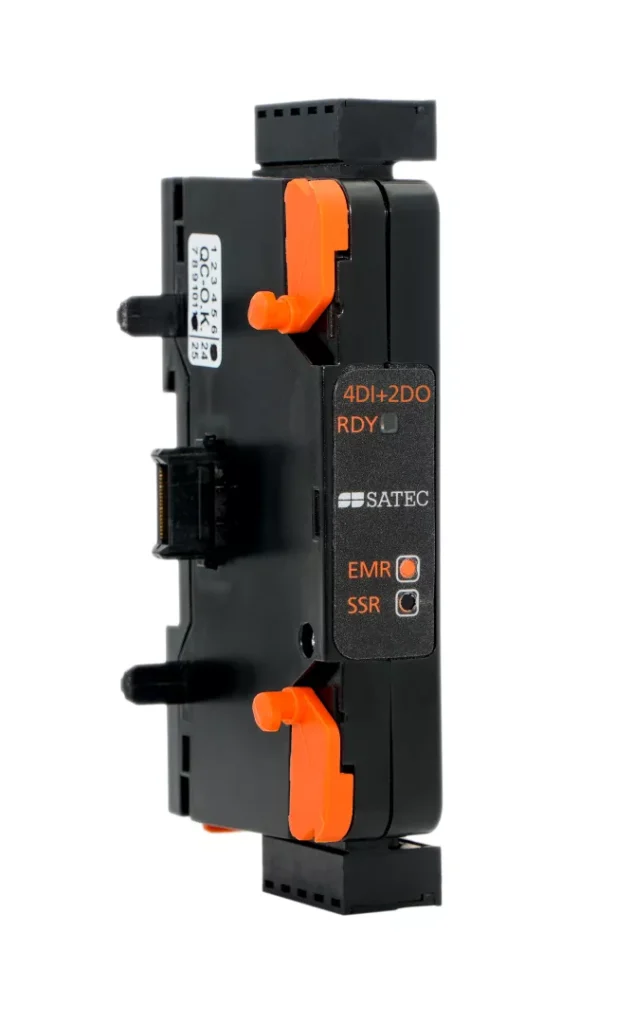
Available per above specifications (DI: @ 24V DC only)
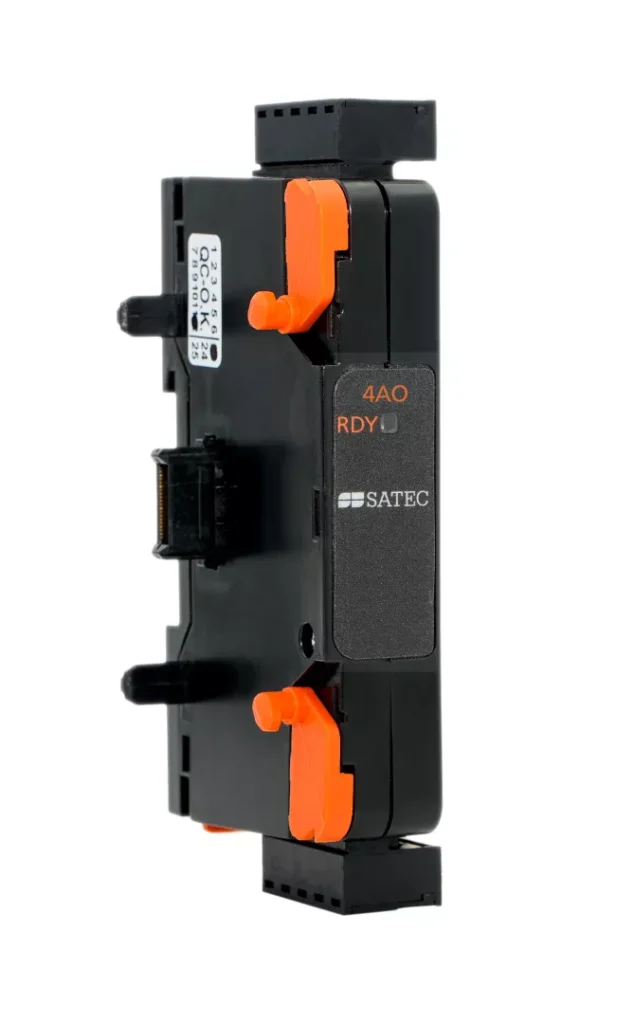
4AO
Universal (configurable) isolated analog outputs
(±1 mA; 0-1 mA; 0-20 mA; 4-20 mA)