Our Solutions
Wide Area Monitoring
Wide-Area Monitoring Systems
The Electrical Power Ecosystem
Electrical power is delivered through a complex, interconnected, multi-level grid. Traditionally, power systems were operated through centralized generation and control. Today, the grid also includes distributed energy resources and microgrids, creating new operational and monitoring challenges.
Because the power system is highly interconnected, even a small disturbance in one location can spread across the network and, in extreme cases, contribute to a widespread outage.
This creates two key challenges. The first is ensuring accurate and reliable post-event analysis using data recorded during the disturbance. The second is improving the accuracy, speed, and communication capabilities of monitoring systems so that developing events can be detected, assessed, and addressed in real time.
PMU per IEEE C37.118.1
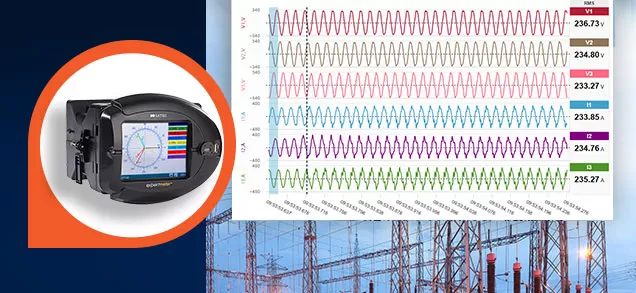
Monitoring voltage and current phasors, together with grid frequency and Rate of Change of Frequency (RoCoF), helps operators detect disturbances, analyze their origin, and track how events develop across the power system. The requirements for these measurements are defined in IEEE C37.118.1, the standard for synchrophasor measurements in power systems.
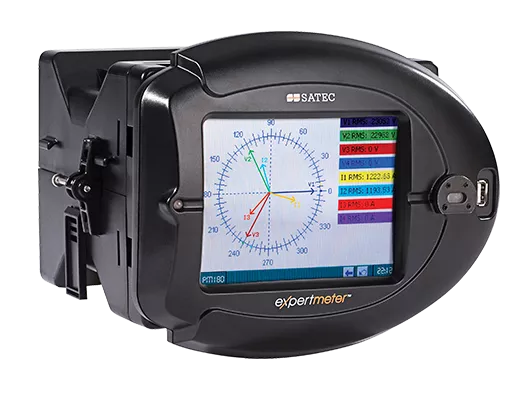
SATEC offers Phasor Measurement Units (PMUs) as either a dedicated device—the PMU PRO—or as an integrated module within the PM180 power quality analyzer.
Supporting both P-Class and M-Class performance requirements, as well as multiple communication protocols, SATEC PMUs provide flexible solutions for real-time grid monitoring, event analysis, and wide-area measurement applications.

Typical WAMS Architecture
Transmission Substation
PM180 PMUDistribution Substation
PM180 PMURenewable Plant / BESS
PM180 PMUPower Generation / IPP
PM180 PMUWAMS / Control Center
Conceptual architecture only. Final implementation depends on project topology and communication design.
What is a PMU / synchrophasor?
A Phasor Measurement Unit measures electrical phasors together with their precise timestamps, allowing voltage and current phase angles to be compared at different locations across a power network.
Unlike conventional meters, which primarily provide local electrical measurements, PMUs deliver time-aligned data for monitoring grid dynamics, phase-angle differences, frequency changes and disturbances.
When connected to Phasor Data Concentrators (PDCs) and Wide-Area Monitoring Systems, PMUs help system operators improve situational awareness and support post-event investigations.
SATEC PMU capabilities
Applications
Standards & compliance
Relevant SATEC products
Frequently Asked Questions
What is the difference between P-Class and M-Class PMUs?
P-Class prioritizes fast dynamic response for protection-oriented applications, while M-Class emphasizes measurement accuracy for monitoring and analysis. SATEC PMU solutions support both performance classes according to IEC/IEEE 60255-118-1:2018.
Which communication protocols do SATEC PMUs support?
SATEC PMUs support IEEE C37.118.2 for synchrophasor data transfer and IEC 61850-9-2 for mapped synchrophasor streaming through the Sampled Values service. Time synchronization is provided through IEEE 1588 PTPv2 or IRIG-B.
What is a PMU used for?
PMUs provide time-synchronized voltage and current phasors, frequency and ROCOF measurements for wide-area grid monitoring, oscillation analysis, disturbance investigation and dynamic performance monitoring of transmission networks, substations, generation facilities and renewable energy plants.
How does a PMU integrate into a Wide-Area Monitoring System (WAMS)?
PMUs installed at different grid locations transmit synchronized measurements to a Phasor Data Concentrator (PDC), which collects and aligns the data for grid-wide visualization, analysis and event investigation.
What is the difference between a PMU and a power quality analyzer?
A power quality analyzer monitors disturbances such as voltage dips, swells, harmonics and transients. A PMU specializes in precisely time-synchronized phasor measurements for comparing grid conditions across different locations. SATEC's PM180 combines both capabilities in one device.